Set of Five Austria 10 Euro Copper Coins Uncirculated Knights Tales
- Seller:
-
blackev
Top Seller

- Feedback:
- Location:
- 378 more ads from this seller
- Entered/Renewed:
- 3 weeks ago
- Ad Views:
- 206


Set of Five Austria 10 Euro Copper Coins Uncirculated Knights Tales
Description
For Sale:
Set of Five Austrian 10 Euro Copper Uncirculated Coins 2019/2020/2021 - Knights' Tales
Country: Austria
Face Value: 10 Euro
Theme: Chivalry, Adventure, Courage, Fortitude, Brotherhood
Collection: Knights' Tales
Position in Series: 5 coins out of 5
Composition: Copper
Quality: Uncirculated
Year: 2019/2020/2021
Weight: 15 g [per coin]
Mintage: 130,000 [per coin]
Coin Shape: Circular
Diameter: 32.00 mm
Edge: Interrupted Reeded
Edge Inscription: None
Packaging: Lighthouse Capsule
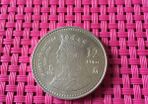
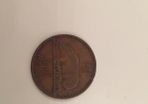
Condition: See images
Certificate: No Certificate Issued
Mint: Austrian Mint AG
Designer: Anna Rastl, Kathrin Kuntner
Shipping Options
Only charge An Post rates (rounded up to nearest Euro)
(Will combine shipping):
* Standard Post (Ireland): €4
* Registered Post (Ireland): €10
* Collection (Bray): Free
Payment Options:
* Bank Transfer.
* PayPal.
* Revolut (Preferred).
* Cash.
Description:
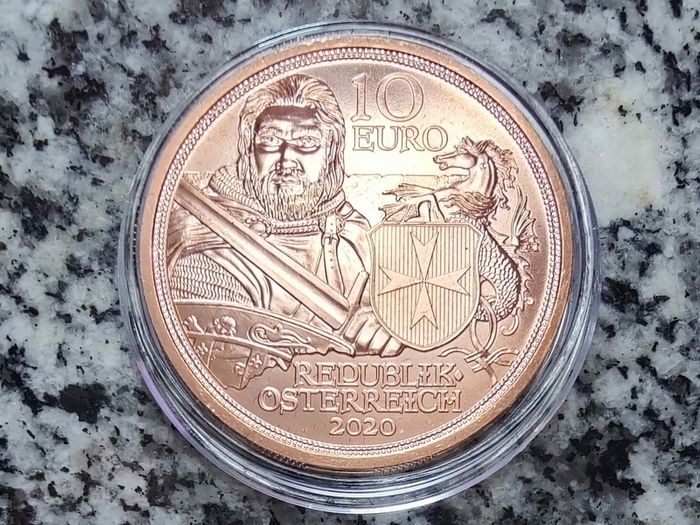
Fortitude
The eight-pointed white cross on a red background is instantly recognisable as the logo of the Order of St John.
The origins of this charitable organisation, which oversees the St John Ambulance organisation worldwide, go back to a knightly order known as the Order of Knights of the Hospital of St John of Jerusalem.
The courage in adversity shown by the 'Hospitallers', as the Order's members were known, is symbolic of fortitude, the pillar of knighthood to which the fourth coin in the Knights' Tales series is dedicated.
Founded in Jerusalem in 1099 by Benedictine Brother Gerard Tum to provide care for sick, poor and injured pilgrims in the Holy Land, the Hospitallers had a major influence on the development of western hospitals.
But in addition to its charitable and religious functions, the Order soon developed an entrepreneurial and military role, with the first armed brothers appearing among the Order's ranks in 1130.
The Hospitallers provided military escort to pilgrims and, from 1136, the Order gained control of numerous important fortresses in the Holy Land.
The eight-pointed cross is a symbol of the struggle against sickness and loneliness, homelessness and hunger, unkindness and neglect, among other things.
The cross features on the Order's coat of arms, which is held on the coin's obverse by a heraldic hippocamp, a mythical creature that was half horse, half fish and originated in Greek mythology.
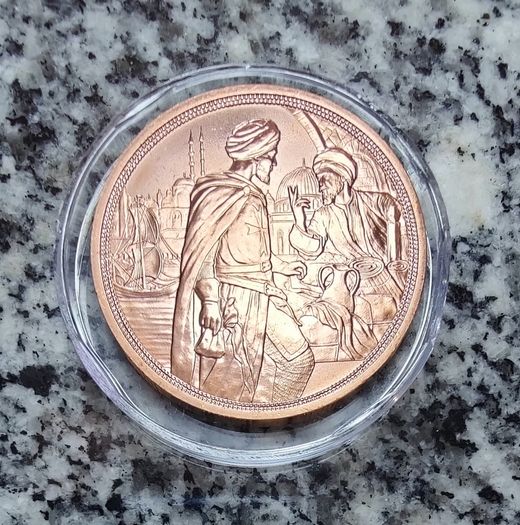
Knights of the Order of St John appear on both the obverse and the reverse of Fortitude, one with sword drawn, the other haggling with a trader at a market stall.
Brotherhood
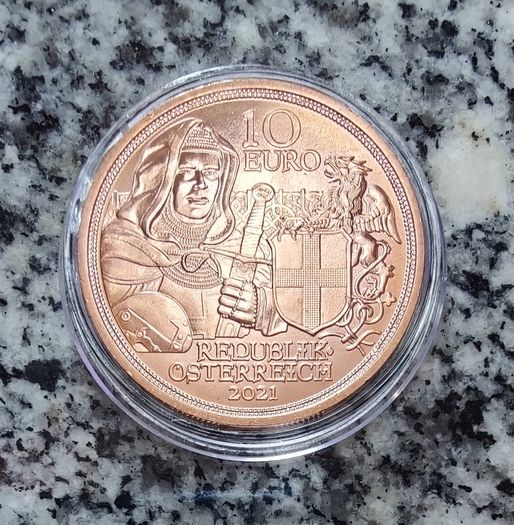
The fifth and final coin in the swashbuckling Knights' Tales series celebrates the Teutonic Order. Named after the Order of Brothers of the German House of Saint Mary in Jerusalem, the Teutonic Order was founded as a military order in the city of Acre in 1190 and is headquartered today in Vienna.
Initially a hospital brotherhood, from 1198 the Teutonic Order began aiding Christians on their pilgrimages to the Holy Land.
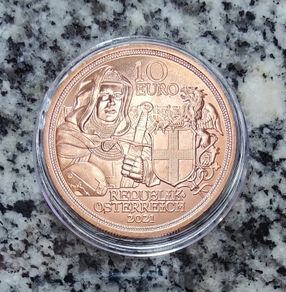
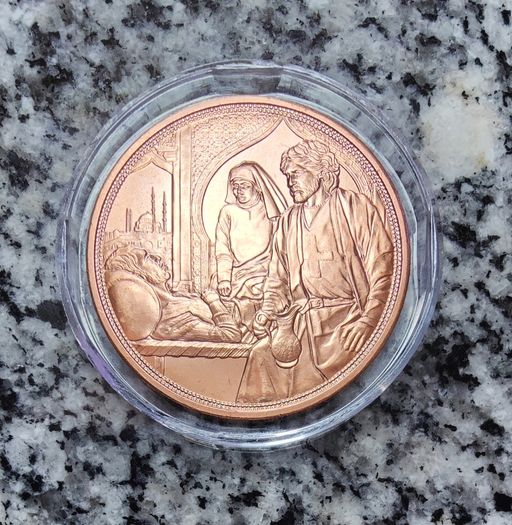
The coin's reverse shows a hospital scene in which a nurse tends to a bed-ridden brother as a concerned Teutonic knight looks on. On the coin's obverse, the coat of arms of the Teutonic order is held by a heraldic griffin.
Hermann von Salza, the fourth Grand Master of the Teutonic Order, was a friend and adviser of Frederick II, who from 1220 to his death in 1250 was Holy Roman Emperor. Born in Ancona in 1194, Frederick spent his youth in Sicily and spoke six languages, among them Arabic.
As an informant of the Pope reported: "The 12-year-old may only be a boy, but he already has the character of a king". Frederick's court became an important centre for the study of science and poetry.
As one of the most important supporters of the Teutonic order, Frederick gained a good reputation both across Europe and the Holy Land.
However, Frederick repeatedly postponed the crusade he had planned to embark upon and was subsequently ex-communicated by Pope Gregory IX in 1227.
Although rejected by the Christian community, he eventually set off for the Holy Land in 1228 and won back the pilgrimage sites of Jerusalem, Bethlehem and Nazareth without a struggle.
Through peaceful negotiations over a period of months Frederick eventually reached an agreement with Sultan Al-Kamil.
The Holy Roman Emperor was crowned King of Jerusalem in 1229.
Courage
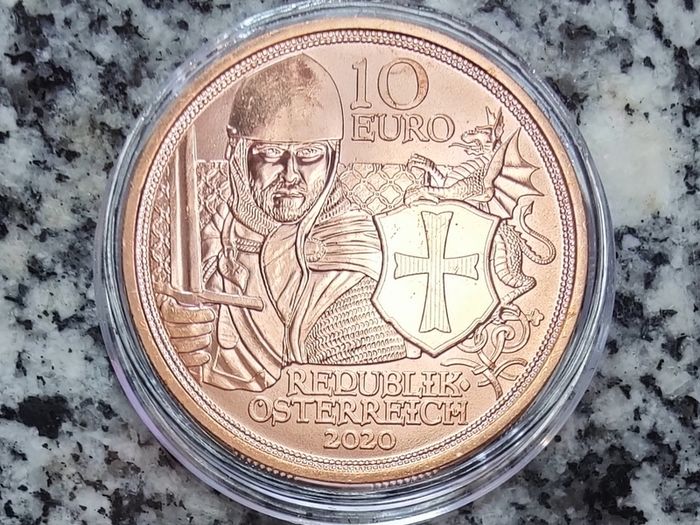
Founded during the Crusades, the Order of the Knights Templar unified the monastic life with the ideals of knighthood.
Bound by poverty, chastity and obedience, the Templars lived a life of godliness and were forbidden to partake of worldly temptations, but were also considered an elite military troop.
Uncompromisingly brave, they epitomised the knightly concept of 'courage', to which the third coin in the swashbuckling five-coin Knights' Tales series is dedicated.
In the 12th and 13th centuries, the Holy Land was the principal focal point of most knights.
Driven by a combination of economic interest and spirituality, knights would head to the eastern Mediterranean with thoughts of conquest and the fulfilment of their religious vows.
However, after the conquest of Jerusalem in 1099, the crusaders were constantly on the defensive, leading French knight Hugo von Payns and a small group of like-minded men to found the Order of the Knights Templar in 1118.
The rules of the Order determined that the Templars dress in a white monastic habit but that did not stop them fighting horseback and taking part in many campaigns, as can be seen on the coin's obverse, which shows a member of the Knights Templar ready for battle, sword in hand.
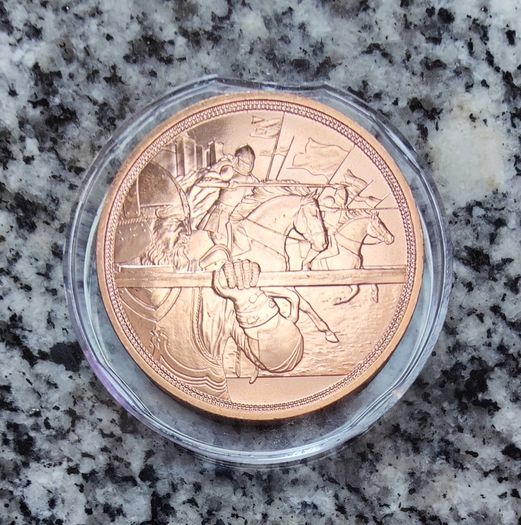
To the right is the red cross worn on the robes of the Templars, which was a symbol of martyrdom. The reverse shows a combat scene in which two knights ride into battle with their lances lowered.
An infantryman, spear in hand, is seen in the foreground, a castle in the background.
Adventure
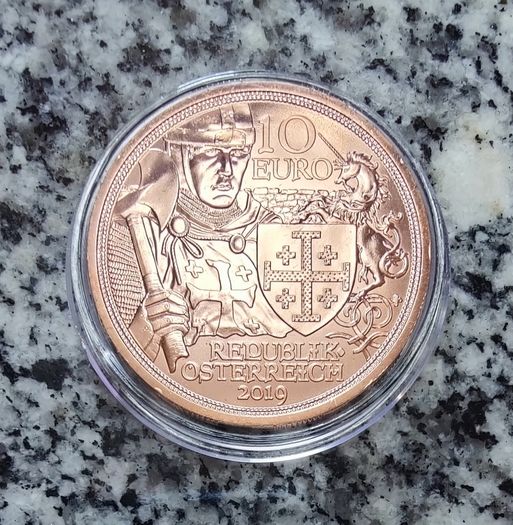
Godfrey of Bouillon was one of the leaders of the First Crusade.
Considered a chaste and daring knight whose victories were romanticised during his lifetime, Godfrey epitomised the spirit of adventure, the theme of the superb second coin in the swashbuckling Knights' Tales series, in which we travel back in time to a bygone age of knightly virtues.
Having joined the First Crusade in 1095, at the request of Pope Urban II, Godfrey and the army of crusaders travelled along the Rhine and Danube rivers, taking different routes to get to Constantinople, where they reunited.
The talk was of an army of 50,000 men, among them 7,000 knights.
After three long, harsh years, the rest of the crusaders finally made it to Jerusalem in the summer of 1099.
Following a month-long siege, they conquered the Jerusalem Citadel, and murdered Jews and Muslims in acts of bloody retribution. The first ruler of the Kingdom of Jerusalem, Godfrey of Bouillon died in Jerusalem in 1100.
Godfrey was the also first to use the cross of Jerusalem.
The kingdom's coat of arms featured a golden cross potent on a silver background surrounded by a smaller Greek cross in each quadrant.
The cross of Jerusalem features in the centre of the coin's obverse, both on a coat of arms and on the chest of Godfrey of Bouillon, who is holding a battle axe and wearing a helmet, chainmail and other armour as if ready for battle.
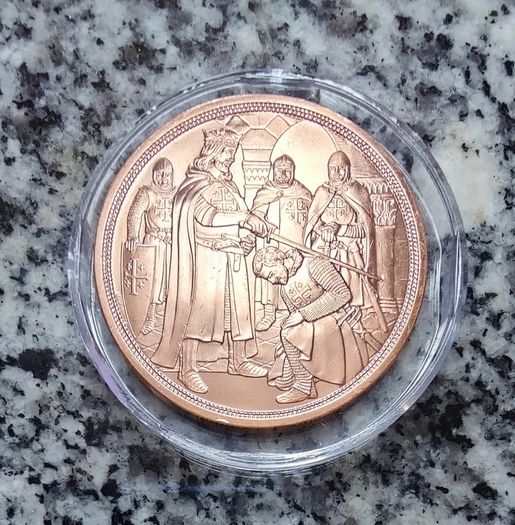
The coin's reverse shows knighthood being conferred by a king to a kneeling squire in the form of the accolade, also known as the dubbing ceremony.
Chivalry
Knights' Tales is a fascinating five-coin series in which we travel back in time to a bygone age that was notorious for being bloody and brutal.
But the Middle Ages was also the age of chivalry, when high-born warriors known as knights rode into battle on horseback dressed in full armour.
The code of chivalry was a combination of the warrior ethos, piety, nobility and gallantry.
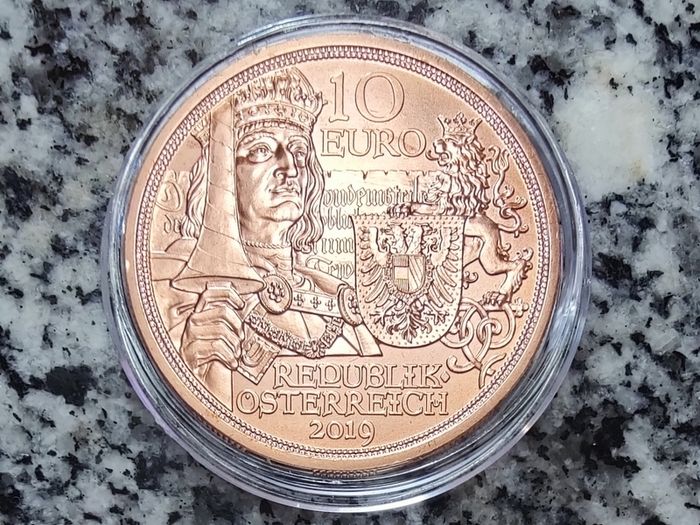
To his loyal subjects, Maximilian I, to whom the first coin in the series is dedicated, embodied these values.
The year 2019 is the 500th anniversary of the death of the Holy Roman Emperor and Archduke of Austria.
Maximilian I was born in 1459, at the end of the Middle Ages. In 1477, he married Mary of Burgundy, which made him not only Duke of Burgundy, but also Sovereign of the knightly Order of the Golden Fleece.
With a membership limited to just 30, this exclusive club was effectively the 'créme de la créme' of the noble elite.
Not everything that Maximilian was involved with was noble and chivalrous, however.
Under pressure from the Estates of the realm, as well as for his own material benefit, he agreed to the expulsion of the Jews from the Austrian provinces of Styria and Carinthia. Yet Maximilian was also something of a 'renaissance man' who could speak seven languages and passionately supported the fine arts.
The coin's obverse features a portrait of Maximilian I on the left, in which the Holy Roman Emperor is holding a lance.
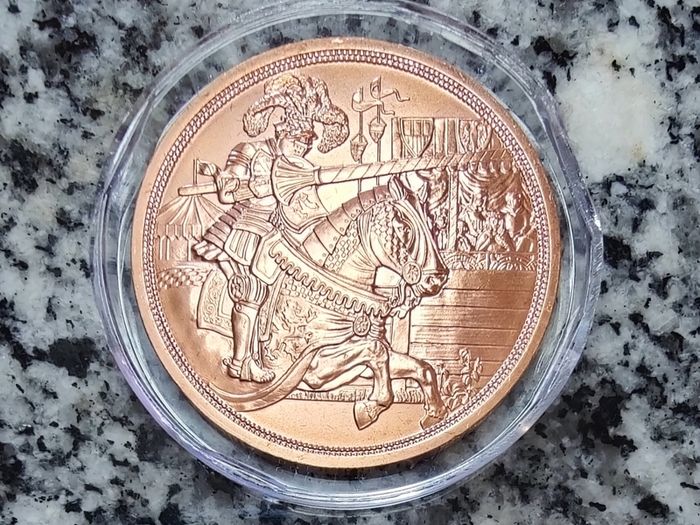
On the right, his coloured-applied coat of arms is held by a heraldic lion. The reverse shows a scene from a jousting tournament, in which a knight on horseback is in full gallop as seated spectators look on from a stand. Maximilian I was famous for his bravery when jousting.
 Post/CourierTo be arranged Bank transferTo be arranged
Asking Price: €75  No swaps
More Similar Ads


See more in our Coins category available today