The Atlas of the Solar System by Patrick More & Gary Hunt + The Observer's Sky Atlas
- Seller:
-
Dbros
Top Seller

- Feedback:
- Location:
- 135 more ads from this seller
- Entered/Renewed:
- 41 minutes ago
- Ad Views:
- 19


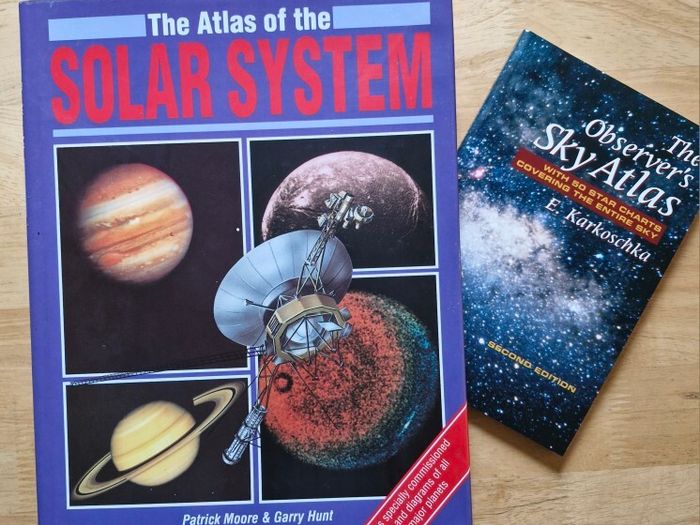

The Atlas of the Solar System by Patrick More & Gary Hunt + The Observer's Sky Atlas
Description
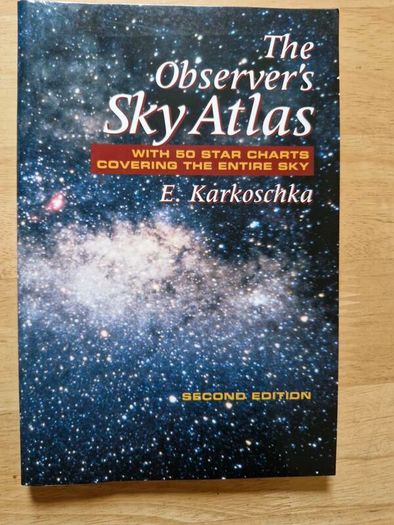
The Atlas of the Solar System by Patrick More & Gary Hunt + The Observer's Sky Atlas by E Karkoschka
Authors: Sir Patrick Moore & Dr. Gary Hunt
Publisher & Format: Royal Astronomical Society / Mitchell Beazley (Hardcover with Dust Jacket, Large Folio Format, ~320 pages).
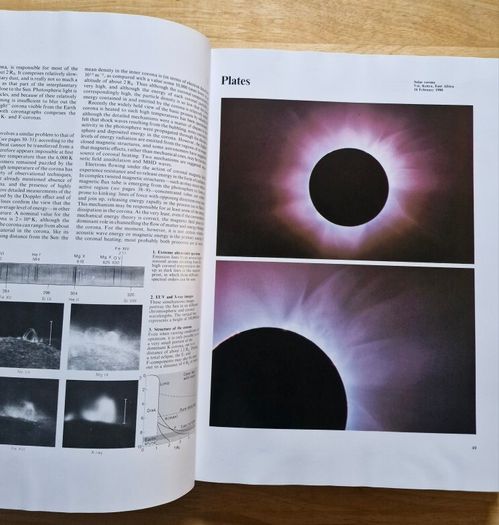
Core Subject: A comprehensive planetary geography atlas packed with high-resolution photographic maps, orbital data, topographic charts, and mission imagery from NASA’s Voyager, Mariner, and Viking probes.
Scope: Covers every planet, major moon, asteroid belt, and comet known up through the peak space exploration era of the late 20th century.
Sir Patrick Moore (1923–2012): Britain’s iconic astronomer, author, and presenter of the BBC's The Sky at Night for 55 years. He brought narrative clarity and accessible historical context to the text.
Dr. Garry E. Hunt: A prominent planetary scientist who worked directly on major NASA unmanned space missions, including the Voyager 1 and 2 probes to Jupiter and Saturn. His access to telemetry and raw mission data ensured high scientific accuracy for the era.
Institutional Backing: Produced in direct collaboration with the Royal Astronomical Society and drawing heavily from official NASA and USSR Academy of Sciences image archives.
Content & Structure (~464 pages)
The atlas is organized systematically, moving outward through the solar system:
Introduction & History: Early observations, naked-eye astronomy, the evolution of telescopes, and the dawn of space probe exploration.
The Sun: Solar physics, flares, sunspot cycles, and interior dynamics.
The Terrestrial Planets: Mercury, Venus, Earth, the Moon, and Mars. Features full-page surface mapping, geological histories, and lander photos (e.g., Soviet Venera and US Viking missions).
The Outer Giants: Jupiter, Saturn, Uranus, and Neptune, accompanied by detailed mapping of their moon systems (Io, Europa, Titan, etc.) captured during the Voyager flybys.
Minor Bodies & Boundaries: Asteroids, comets (including historical records of Halley’s Comet), meteors, and the outer edges of the solar system.
The Observer's Sky Atlas
The Atlas of the Solar System
Author: Erich Karkoschka
Publisher & Format: Springer (Paperback / Flexibound, Compact Field Guide, ~130–160 pages).
Core Subject: A essential field reference for amateur astronomers detailing star charts, deep-sky objects, double stars, and nebulae visible with binoculars or small-to-medium telescopes.
Scope: Features clear night-sky constellation charts matched with detailed data tables on apparent magnitude, coordinates, distance, and visual target descriptions.
The Atlas of the Solar System (first published in 1983 by Mitchell Beazley in association with the Royal Astronomical Society, and updated in 1990) is widely considered a landmark popular astronomy reference from the late 20th century.
Visual Mapping Quality: Unlike typical narrative books, this was designed specifically as an atlas. It includes comprehensive global maps of planets and moons with named topographic features (craters, basins, valleys, volcanoes) officially recognized by the IAU (International Astronomical Union).
Golden Age of Exploration Snapshot: It preserves the exact scientific baseline of the 1980s space boom—capturing the excitement of the first close-up planetary flybys before the modern rover and orbiter era.
Both in Excellent condition
Can meet in Tralee or Listowel
Can post
 Post/Courier Paypal
Asking Price: €20  No swaps
More Similar Ads












See more in our Non-fiction category available today