Rare Prussian award medal to British sailor
- Seller:
- Medalsandbadges
- Feedback:
- Location:
- 5 more ads from this seller
- Entered/Renewed:
- 1 hour ago
- Ad Views:
- 94


Rare Prussian award medal to British sailor
Description
here is an article about the medal and its owner:
John Rossetter and the Mystery of the Prussian Medal
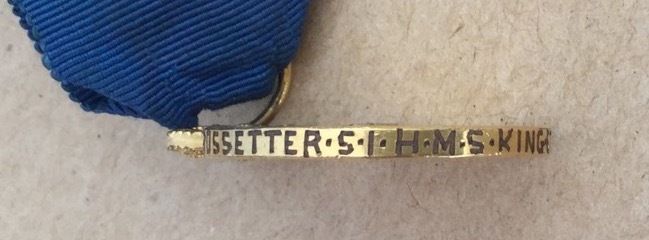
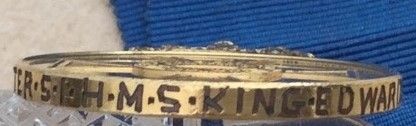
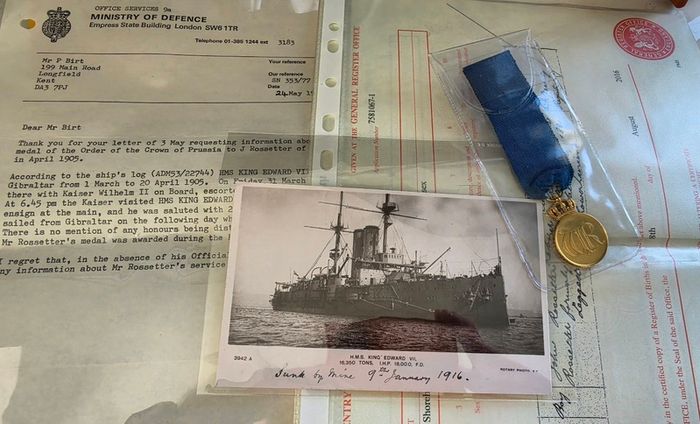
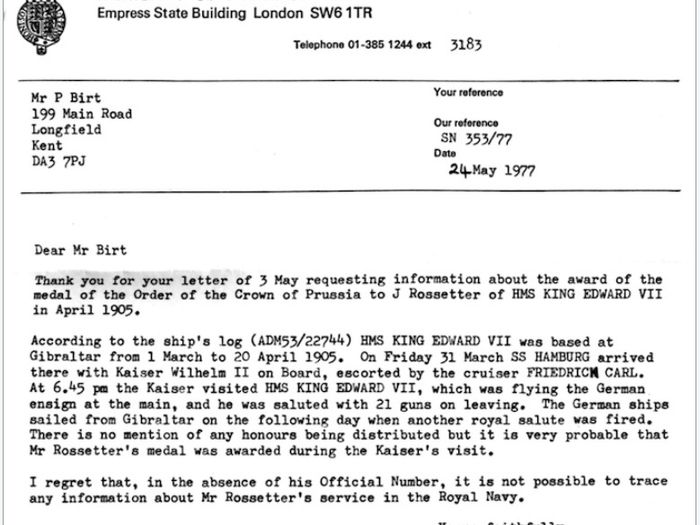
Among the many medals awarded to British servicemen during the late Victorian and Edwardian eras, few are more intriguing than foreign decorations bestowed by European monarchs. One such mystery surrounds John Rossetter, a Royal Navy signalman and later Signal Boatswain, whose career spanned three decades during a period of immense technological and political change. At the centre of this story is a rare Prussian Royal Order of the Crown, believed to have been awarded in connection with a visit by Kaiser Wilhelm II to HMS King Edward VII in Gibraltar in 1905.
From Sussex Gardener to Royal Navy Signalman
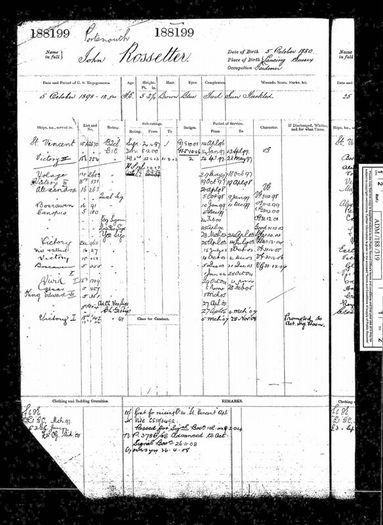
John Rossetter was born at Lower Lancing, Sussex, on 5 October 1880. Before joining the Royal Navy, his civilian occupation was recorded simply as gardener. On his eighteenth birthday, 5 October 1898, he enlisted at Portsmouth for twelve years' service.
Like many naval ratings of his era, Rossetter's early career took him through a succession of training establishments and ships. He began as a boy sailor aboard HMS St Vincent, the famous former 120-gun ship of the line that by the late nineteenth century served as a training vessel. Further service followed in HMS Victory III, HMS Volage, HMS Alexandra, HMS Boscawen, and HMS Canopus.
His aptitude for signalling became evident as the Royal Navy increasingly recognised communications as a specialised profession. During these formative years, Rossetter was part of a generation that witnessed the transformation of naval signalling from a secondary skill into a highly trained specialist branch.
Service on HMS King Edward VII
One of the most significant appointments of Rossetter's career came on 1 March 1905, when he joined the newly commissioned battleship HMS King Edward VII.
The ship had only recently entered service as flagship of the Atlantic Fleet and was based at Gibraltar. Within weeks of Rossetter joining, King Edward VII found itself hosting one of the most powerful men in Europe.
On 31 March 1905, Kaiser Wilhelm II, German Emperor and King of Prussia, arrived in Gibraltar aboard the German liner Hamburg, escorted by German warships. That evening he paid an official visit to HMS King Edward VII, where he was received with full honours. As he departed, a 21-gun royal salute was fired, and further ceremonial exchanges took place the following day.
At the time, such naval visits formed an important part of international diplomacy. The Kaiser was known for his fascination with naval affairs and took a personal interest in warships and their crews.
A Clue in the Admiral's Memoirs
The strongest evidence linking Rossetter to a Prussian award comes not from official records, but from a remarkable anecdote recorded by the fleet commander himself.
Vice-Admiral William Henry May, whose flagship was HMS King Edward VII, later described the Kaiser's visit in his family memoirs. After discussing naval technology with the German ruler, May recalled receiving a humorous message from Wilhelm II following the fleet's departure from Gibraltar:
"H.M. compliments to Admiral May. H.M. was very touched by the Flagship's burning German coal this morning, obscuring the view of the harbour and shrouding the ships in smoke. H.M. thanks the Admiral for the kind little attention. Please send promised signalman."
The final sentence is particularly intriguing:
"Please send promised signalman."
Who was this "promised signalman"?
No documentary proof has yet emerged, but it is tempting to speculate that the signalman in question was John Rossetter. He was serving aboard the flagship at precisely the right time and was already developing a reputation as a highly capable signalling specialist.
If Rossetter was indeed the man referred to by the Kaiser, he may have been seconded for temporary duty aboard the imperial vessel or presented personally to Wilhelm II during the visit.
The Prussian Royal Order of the Crown
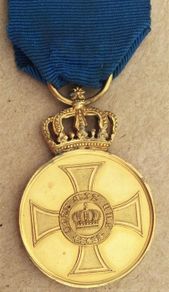
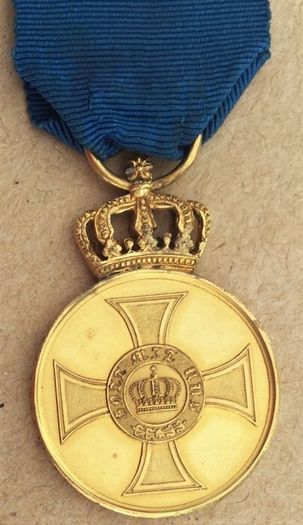
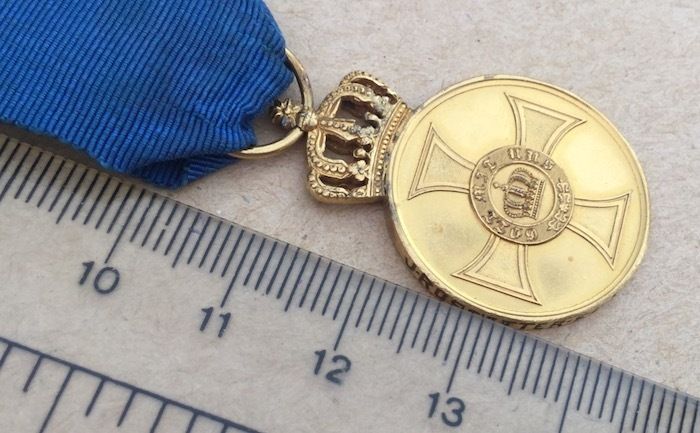
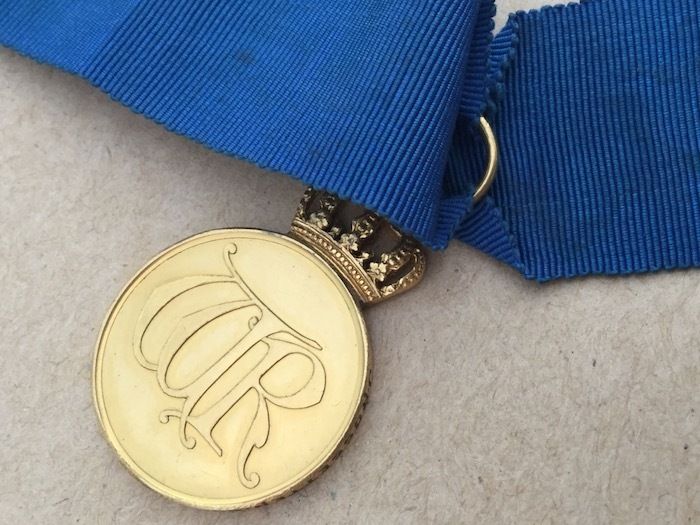
The decoration associated with Rossetter is believed to be the Prussian Royal Order of the Crown (Königlicher Kronen-Orden).
Founded in 1861 by King Wilhelm I of Prussia, the order was frequently awarded to foreign military officers and occasionally to sailors who played notable roles during state visits, diplomatic missions, and royal exchanges. Before the First World War, British and German naval relations were still sufficiently cordial for such honours to be exchanged.
Although no official award citation for Rossetter has yet been located, the timing of his service on HMS King Edward VII and the Kaiser's reference to a "promised signalman" provide a compelling circumstantial link.
For collectors and researchers, the medal remains an unsolved mystery, making Rossetter's group particularly fascinating.
A Distinguished Naval Career
Rossetter's subsequent career demonstrated that he was no ordinary sailor.
Promoted to Acting Signal Boatswain in 1908, he later served in numerous important warships, including HMS Queen, HMS Lord Nelson, HMS Prince of Wales, HMS Defence, Good Hope, Queen Elizabeth, and others.
When the First World War broke out, he was serving aboard HMS Lord Nelson, flagship of the Channel Fleet. He later served aboard HMS Prince of Wales during the Dardanelles campaign.
A 1917 newspaper report reveals another remarkable detail. While serving in the Mediterranean, Rossetter was reportedly aboard HMS Majestic when the battleship was torpedoed and sunk during the Gallipoli campaign in May 1915. If correct, he survived one of the Royal Navy's most significant wartime losses.
His superiors consistently praised his abilities. Service reports described him as:
• "A most zealous and intelligent officer."
• "An excellent signal boatswain."
• "Strongly recommended for advancement."
• "Most able and efficient."
• "Quite the most tactful signal boatswain I have met."
These assessments suggest a man held in exceptionally high regard throughout the fleet.
Family Service and Sacrifice
Military service ran through the Rossetter family. Two of John's brothers also served during the Great War.
His brother Charles Rossetter served with the Royal Engineers, while George Rossetter served with the Royal Sussex Regiment and was awarded the Military Medal for gallantry in 1917.
Together, the three brothers represent a family deeply connected to Britain's military effort during the early twentieth century.
A Tragic End
After more than thirty years in naval service, Rossetter's life ended tragically.
By 1928 he was serving aboard HMS Carysfort as a Commissioned Signal Boatswain. On 5 November 1928, while at Keihan North Dockyard, he died at the age of forty-nine.
His death certificate recorded the cause of death as:
"Asphyxia due to occlusion of the larynx by a malignant growth accelerated by weakness of the heart muscle."
Service records additionally note that he died from asphyxia caused by a malignant growth on the larynx.
A poignant administrative dispute followed. His body was initially released to his cousin, Minnie F. Todd, for burial. Subsequent requests from his father and sister for exhumation and reburial were officially refused, a decision still preserved in his service papers.
An Enduring Mystery
Today, John Rossetter's story remains intertwined with one unanswered question: how did a Royal Navy signalman come to possess a Prussian decoration from Kaiser Wilhelm II?
The surviving evidence does not yet provide a definitive answer. No award record has been located, and the Kaiser's cryptic request to Admiral May remains open to interpretation. Yet the coincidence is striking. Rossetter was serving aboard the flagship at the exact moment of the imperial visit, belonged to the signalling branch specifically mentioned by the Kaiser, and appears to have been an exceptionally capable specialist.
Until further records emerge, the Prussian medal remains one of the most intriguing mysteries associated with a Royal Navy signalman of the Edwardian era. What is beyond doubt, however, is that John Rossetter lived a remarkable life of service, spanning the age of imperial diplomacy, the dawn of modern naval communications, and the upheaval of the First World War. His medal, whether awarded directly by the Kaiser or not, remains a tangible reminder of a vanished world and an extraordinary naval career.
 To be arranged PaypalBank transferTo be arranged

Asking Price: €190  No swaps
See more in our Other Antiques & Collectables category available today