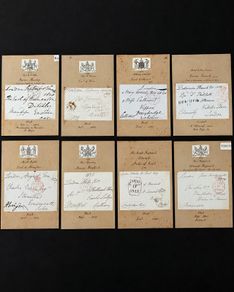
1811-1834 Parliamentary Free Franks x 8 Attributed Major James Bailie Collection
- Seller:
- MetalDesign
- Feedback:
- Location:
- 10 more ads from this seller
- Entered/Renewed:
- 2 hours ago
- Ad Views:
- 43


1811-1834 Parliamentary Free Franks x 8 Attributed Major James Bailie Collection
Description
Addition information and research can be shared via email.
Item Specifics
Type: Parliamentary Free Franks / Postal History / Autographs
Era: Georgian / Early Victorian
Dates: c.1811-1834, with later annotations to 1865
Country/Region: Great Britain / Ireland
Number of Items: 8 mounted album fragments
Original/Reproduction: Original period material
Features: Signed franks, manuscript annotations, heraldic arms, page numbering, cross-references
Provenance: Attributed through research to the collection of Major James Bailie of Ringdufferin
Condition: Antique mounted paper material with age-related toning, spotting and handling wear. Please study all photographs carefully.
Description
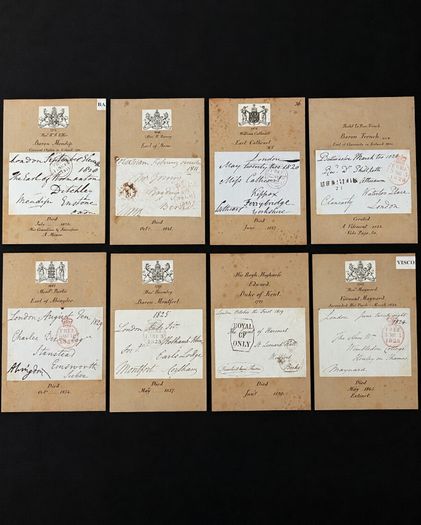
Offered as one complete group are eight early 19th-century British Parliamentary Free Frank album fragments, each mounted with handwritten biographical information and, on several examples, printed coats of arms.
The fragments appear to have originated from a much larger, carefully organised nineteenth-century peerage and Parliamentary Free Frank collection.
They are being offered with a researched attribution to the documented collection of Major James Bailie of Ringdufferin, Co. Down (1823-1896).
The Bailie attribution is supported by a number of unusual structural similarities described below, but a direct documentary provenance link has not yet been independently established. Prospective buyers are therefore encouraged to carry out their own research and verification.
The Eight Franks
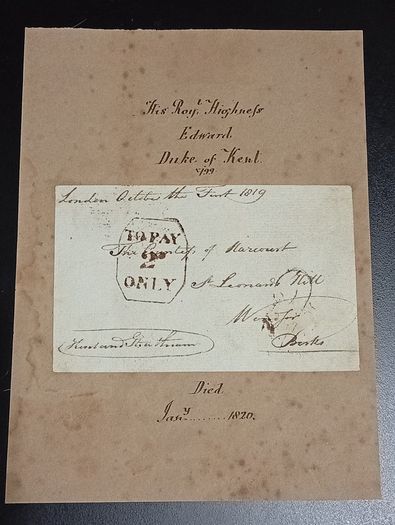
1. Prince Edward, Duke of Kent & Strathearn (1767-1820)
Fourth son of King George III and father of Queen Victoria.
Frank dated 1 October 1819, addressed to Mary, Countess Harcourt, at St Leonard’s Hill, Windsor.
Queen Victoria had been born on 24 May 1819, only a little over four months before this frank was sent.
Prince Edward died on 23 January 1820, less than four months later.
This places the piece within the final months of his life and firmly within the royal/Windsor aristocratic circle.
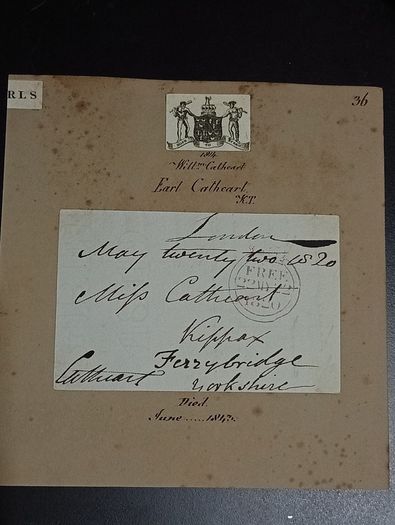
2. William Schaw Cathcart, 1st Earl Cathcart (1755-1843)
Distinguished British general, diplomat and ambassador to Russia during the Napoleonic period.
Frank dated 22 May 1820, addressed to Miss Cathcart at Kippax, near Ferrybridge, Yorkshire.
The recipient was likely a member of the Cathcart family.
Most importantly, the original album mount retains the manuscript number:
36
This page number became central to reconstructing the original collection.
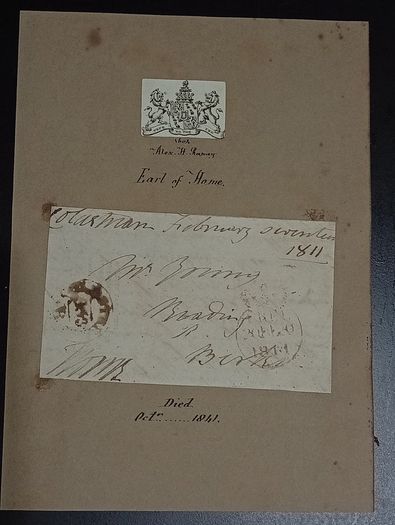
3. Alexander Ramey-Home, 10th Earl of Home (1769-1841)
Scottish peer and Scottish Representative Peer from 1807.
Frank dated approximately 1811, sent from Coldstream to a Mr Young in Reading.
His inclusion is consistent with a systematic collection designed to represent members and designated titles of the House of Lords.
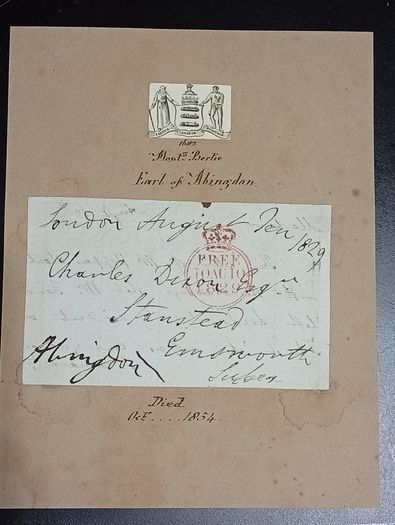
4. Montagu Bertie, 5th Earl of Abingdon (1784-1854)
British peer and long-serving member of the House of Lords.
Frank dated 10 August 1829, addressed to Charles Dixon Esq., Stansted, Emsworth, Sussex.
Dixon was associated with Stansted Park and was a wealthy merchant, landowner and philanthropist.
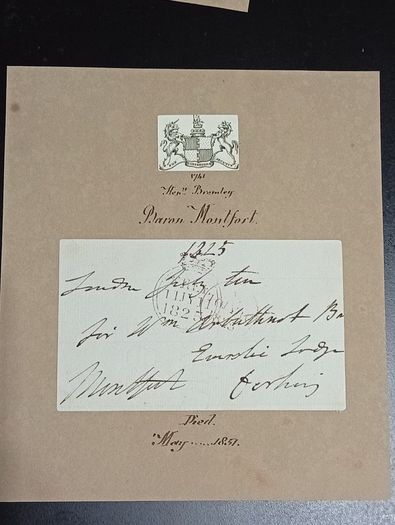
5. Henry Bromley, 3rd Baron Montfort (1773-1851)
Third and final Baron Montfort, with the title becoming extinct on his death.
The early-1820s front appears to be addressed to Sir William Ogilvy, Bt., probably Rear-Admiral Sir William Ogilvy of Inverquharity.
Recipient identification remains provisional.
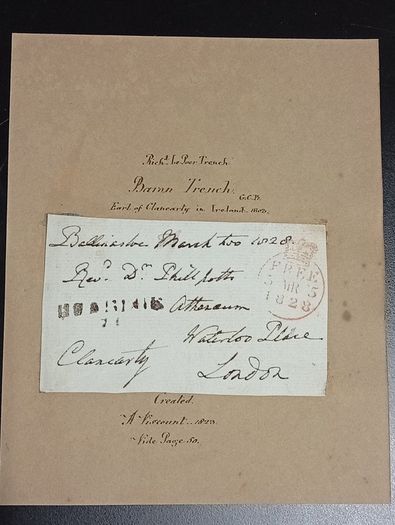
6. Richard Le Poer Trench, 2nd Earl of Clancarty (1767-1837)
Major diplomat and statesman, British plenipotentiary at the Congress of Vienna, and an important figure in the post-Napoleonic settlement of Europe.
Frank dated 2 March 1828, addressed to Rev. Dr Henry Phillpotts, later Bishop of Exeter.
The mount contains the important manuscript instruction:
“Created A Viscount 1823. Vide Page 50.”
This appears to direct the reader to a separate entry for Trench’s later title of Viscount Clancarty.
This internal cross-reference is one of the strongest clues to the structure of the original album.
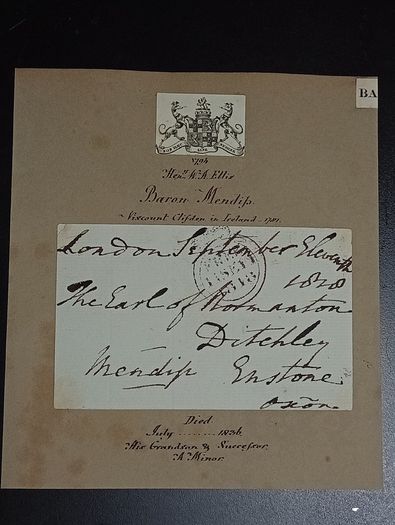
7. Henry Welbore Agar-Ellis, 2nd Viscount Clifden and Baron Mendip (1761-1836)
Frank dated 11 September 1830, addressed to Welbore Ellis Agar, 2nd Earl of Normanton (1778-1868).
The sender and recipient were first cousins, making this genuine correspondence within the interconnected Agar-Ellis Anglo-Irish aristocratic family.
The individual is represented under the title Mendip, demonstrating that the collection appears to have been organised by specific peerage title rather than simply by the best-known title of the individual.
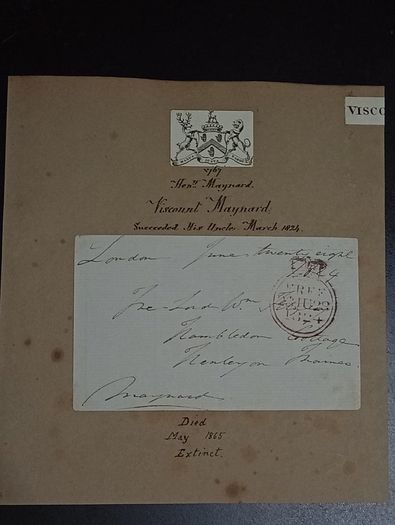
8. Henry Maynard, 3rd Viscount Maynard (1788-1865)
The final Viscount Maynard.
Frank dated 28 June 1834.
The mount records:
“Succeeded His Uncle March 1824”
and later:
“Died May 1865. Extinct.”
This later annotation is extremely important because it proves the album was still being updated after May 1865.
Why Major James Bailie?
Major James Bailie of Ringdufferin, Co. Down (1823-1896) was a serious and well-documented nineteenth-century collector of Parliamentary Free Franks.
In 1880, Bailie publicly described his collection as consisting of three volumes.
His second volume was described as being arranged alphabetically around the spiritual and temporal members of the House of Lords, representing the differently designated titles between the Union of 1801 and the abolition of Parliamentary franking in 1840.
He specifically described the franks as being accompanied by short biographical notices.
The surviving fragments offered here show a remarkably similar structure:
• Parliamentary Free Franks mounted on album fragments
• Peerage-title based organisation
• Handwritten biographical notes
• Printed heraldic coats of arms
• Manuscript page numbering
• Separate treatment of different titles held by the same individual
• Internal page cross-references
• Later updates to title succession and extinction
Page 36 to Page 50
One surviving fragment, Earl Cathcart, retains page 36.
The Trench fragment directs the reader to page 50 for the later title of Viscount Clancarty.
A reconstruction of the relevant alphabetical peerage sequence between Cathcart and Clancarty produced the expected intervening titles and lands on Clancarty at page 50.
That fourteen-position relationship is one of the strongest pieces of evidence suggesting the fragments once formed part of a systematic alphabetical peerage collection.
A separate reconstruction involving Maynard, Mendip and Montfort also produced intervals consistent with the predicted sequence.
Contemporary Recognition of Bailie’s Collection
By 1894, contemporary autograph literature described Major Bailie’s collections as the:
“gleanings of fifty years”
and as large and complete.
It was also recorded that Bailie had incorporated the earlier Free Frank collections of:
Lady Chatham
and
Lord William FitzRoy
into his own holdings.
In 1910, A. M. Broadley again discussed Bailie’s Free Frank collection and described it as exceptionally comprehensive.
Bailie was therefore not an unknown casual collector, but a recognised nineteenth-century specialist whose collection had been built over decades and incorporated material from earlier important collections.
Heraldic Material
Six of the mounts include small printed coats of arms.
Research indicates that these are strongly consistent with early nineteenth-century Debrett peerage armorial plates.
The exact edition has not been proven, but the heraldic material is entirely consistent with the period and with the construction of a serious nineteenth-century peerage reference collection.
Later Provenance Research
Major James Bailie died in 1896.
His estate was administered by his daughter Harriet Louisa Bailie of Ringdufferin, creating a plausible route for his personal collections to remain within the family home.
The Bailie family remained associated with Ringdufferin until the death of the final surviving daughter, Louisa, in 1941.
Ringdufferin was subsequently acquired by the Mackie family in 1945.
Historical research suggests that older Bailie material and family objects continued to survive at Ringdufferin, although the Free Frank albums themselves have not yet been specifically documented in surviving inventories.
Important Attribution Disclaimer
These eight fragments are being offered as:
“Attributed to the Parliamentary Free Frank collection of Major James Bailie of Ringdufferin.”
The attribution is based on extensive historical, structural and comparative research.
However, no surviving inventory, labelled Bailie album page, authenticated handwriting comparison or uninterrupted documentary provenance has yet been found which conclusively proves that these exact fragments came from Bailie’s collection.
For that reason:
Independent research and verification are strongly recommended before purchase. 1. Prince Edward, Duke of Kent and Strathearn (1767–1820)
Who was the signer?
Prince Edward Augustus was the fourth son of King George III and Queen Charlotte and the father of the future Queen Victoria.
Queen Victoria was born at Kensington Palace on 24 May 1819. This frank was sent only a little over four months later.
Edward died of pneumonia at Sidmouth on 23 January 1820, less than four months after this frank was sent. The piece therefore belongs to the final months of his life.
The Royal Archives preserve a substantial body of Edward’s correspondence, confirming his historical importance as a royal, soldier and administrator.
Recipient and historical connection
The addressee, Mary, Countess Harcourt, places the item within the Windsor/aristocratic circle. Her husband, William Harcourt, 3rd Earl Harcourt, was a senior military and court figure.
The timing is unusually attractive: the letter falls between the birth of Victoria and the death of her father.
Why this individual frank matters
Exceptional within the group. It combines a royal signature/free-frank privilege, direct connection to Queen Victoria’s father, a tight historical date window, and an aristocratic Windsor recipient. It is probably the strongest individual piece for a general historical or royal collector.
Value to the wider collection investigation
The Kent mount also shows the same biographical mounting style as the rest of the group, helping establish that a royal duke was deliberately integrated into the same peerage-reference system rather than added later as an isolated autograph.
2. William Schaw Cathcart, 1st Earl Cathcart (1755–1843)
Who was the signer?
Cathcart was a distinguished soldier, diplomat and general. He served in the American War of Independence, commanded the British expedition to Copenhagen in 1807 and later represented Britain at the Russian court during the Napoleonic Wars.
His career places this frank within the world of high military command and diplomacy immediately after the Napoleonic period.
Recipient and historical connection
Kippax was associated with Cathcart’s younger brother, the Rev. Archibald Hamilton Cathcart. The addressee is therefore plausibly a niece or close female relative, although this has not been conclusively identified.
The mount retains the manuscript page number “36”. This is one of the most important physical clues in the entire collection.
Why this individual frank matters
Very high. Cathcart is historically significant in his own right, but this piece is even more important as an artefact of the original album because page 36 anchors the reconstructed pagination sequence.
Value to the wider collection investigation
The page number 36 can be tested against the Trench/Clancarty instruction “Vide Page 50”. The fourteen-position gap between Cathcart and Clancarty can be filled by a historically plausible alphabetical sequence of peerage titles, making Cathcart one of the most important pieces for the possible Bailie attribution.
3. Alexander Home (later Ramey-Home), 10th Earl of Home (1769–1841)
Who was the signer?
Alexander Home succeeded as 10th Earl of Home in 1786 and served as a Scottish Representative Peer from 1807 until his death in 1841.
He did not legally adopt the additional surname Ramey-Home until 1814, an important chronological detail when interpreting earlier correspondence.
Recipient and historical connection
As a Scottish Representative Peer, Home is especially relevant to a systematic House of Lords collection because Scottish peers did not automatically sit in the Lords after the Union; representative peers were elected to serve.
The identity of the Reading addressee, Mr Young, has not yet been established.
Why this individual frank matters
High. The piece is one of the earliest in the group and represents a constitutionally interesting category of peer: a Scottish Representative Peer. That makes it more than an aristocratic signature; it has direct relevance to the political structure Bailie was documenting.
Value to the wider collection investigation
Home fits the theory of a collection intended to represent the actual titled membership of the House of Lords after the Union. It is therefore useful evidence for the breadth and constitutional logic of the collection.
4. Montagu Bertie, 5th Earl of Abingdon (1784–1854)
Who was the signer?
Montagu Bertie succeeded as 5th Earl of Abingdon in 1799 and remained a prominent landed peer until his death in 1854.
He later served as Lord Lieutenant of Berkshire from 1826, placing him firmly within the county and aristocratic establishment.
Recipient and historical connection
Charles Dixon purchased Stansted Park in 1826. Historic England and local heritage sources describe him as the owner who significantly altered the estate; other local sources identify him as a wine merchant and notable philanthropist.
The 1829 date falls only three years after Dixon acquired Stansted, making the address historically coherent.
Why this individual frank matters
Moderate to high. The signer is a substantial peer, while the recipient gives the frank a clear connection to Stansted Park and an identifiable landed-philanthropic figure. It has strong social-history appeal even if it is less headline-grabbing than Kent or Clancarty.
Value to the wider collection investigation
Abingdon contributes another securely identifiable peerage title to the alphabetical structure and demonstrates that the collector was not merely selecting famous military or royal names, but systematically covering peerage designations.
5. Henry Bromley, 3rd Baron Montfort (1773–1851)
Who was the signer?
Henry Bromley was the third and final Baron Montfort of the 1741 creation. He succeeded in 1799 and died on 30 April 1851, when the peerage became extinct.
That extinction gives the mount additional historical interest because it records a peerage that ended with this individual.
Recipient and historical connection
The addressee appears to be a Sir William Ogilvy. One plausible identification is Rear-Admiral Sir William Ogilvy of Inverquharity, 8th Baronet, a long-serving Royal Navy officer who died in 1823. Because the handwriting/postmark reading is not fully secure, this identification must remain tentative.
If the Ogilvy reading is confirmed, the front would connect a final holder of an extinct peerage with a Georgian naval officer and baronet.
Why this individual frank matters
High as a peerage-history piece because Montfort was the final holder and the title became extinct on his death. The possible naval recipient adds further interest, but should not be marketed as confirmed until independently verified.
Value to the wider collection investigation
Montfort is valuable to the internal sequence because it forms part of the independent M-section test. The predicted Mendip-to-Montfort interval later matched the reconstructed title sequence, giving this mount research importance beyond its standalone autograph value.
6. Richard Le Poer Trench, 2nd Earl of Clancarty and 1st Viscount Clancarty (1767–1837)
Who was the signer?
Clancarty was an important Anglo-Irish politician and diplomat. He served in senior government offices and undertook major diplomatic work during the final defeat of Napoleon and the settlement of Europe.
He was a British plenipotentiary at the Congress of Vienna and later ambassador to the Netherlands.
Henry Phillpotts, the recipient, became Bishop of Exeter and was one of the most prominent and controversial High Church/Tory churchmen of the nineteenth century.
Recipient and historical connection
This is therefore correspondence between two politically significant establishment figures, even though the contents of the original letter do not survive.
The mount contains the key manuscript note: “Created A Viscount 1823. Vide Page 50.” This directs the reader to a separate entry for the later title of Viscount Clancarty.
Why this individual frank matters
Exceptional for research and very high historically. Clancarty’s Congress of Vienna career gives the signer international significance, Phillpotts is a notable recipient, and the surviving cross-reference is probably the single most diagnostic annotation in the group.
Value to the wider collection investigation
This piece strongly supports a title-based collection rather than a simple person-based autograph album. The collector appears to have treated Baron Trench and Viscount Clancarty as separate designated-title entries — exactly the kind of system Major James Bailie described in 1880.
7. Henry Welbore Ellis, 2nd Viscount Clifden and 2nd Baron Mendip (1761–1836)
Who was the signer?
Born Henry Welbore Agar, he succeeded his father as 2nd Viscount Clifden and in 1802 inherited the British barony of Mendip from his great-uncle Welbore Ellis, 1st Baron Mendip. He later legally assumed the surname Ellis.
This is particularly relevant because the surviving mount identifies him under the title “Baron Mendip”, rather than simply under the better-known Viscount Clifden title.
Recipient and historical connection
The recipient, Welbore Ellis Agar, 2nd Earl of Normanton, came from the closely related Agar family. Their fathers were brothers, making the sender and recipient first cousins.
The front is therefore genuine intra-family aristocratic correspondence within the Anglo-Irish Agar/Ellis network.
Why this individual frank matters
Very high for understanding the collector’s method. The family connection is attractive, but the key importance is the use of “Mendip” as the filing/title identity. It shows the collector cared about distinct peerage designations, not merely the individual’s principal title.
Value to the wider collection investigation
Mendip is central to the independent M-section sequence test. Together with Maynard and Montfort it provided a second check on the proposed alphabetical architecture, independent of the Cathcart/Clancarty page-number evidence.
8. Henry Maynard, 3rd Viscount Maynard (d. 19 May 1865)
Who was the signer?
Maynard succeeded his uncle to the viscountcy in 1824 and served as Lord Lieutenant of Essex from 1825 until his death.
He died on 19 May 1865. The viscountcy became extinct at his death, a fact explicitly recorded by the later annotation on the mount.
Recipient and historical connection
The front appears to be addressed to Rev. William Mussage Kirkwall Bradford at Hambleden. Bradford married Mary Ridley at Hambleden on 1 July 1834, only three days after the frank date. The coincidence is intriguing, but there is no surviving letter content proving that the correspondence concerned the marriage.
The mount records both his succession and the later note “Died May 1865. Extinct.”
Why this individual frank matters
Exceptional for dating the album’s annotation history. The frank itself is a good peerage free front, but the major value is the 1865 extinction note: it proves that the mounted collection was still being updated after May 1865.
Value to the wider collection investigation
This annotation rules out any collector who died before 1865 as the person responsible for the final state of the mount. It materially strengthens Major James Bailie (1823–1896) as a plausible compiler and weakens earlier alternatives such as Cordelia Whewell, who died in 1855.
 DeliveryPost/CourierTo be arranged
Asking Price: €750  No swaps
See more in our Stamps category available today